Scarpology Book on Improvisation: a look into the book
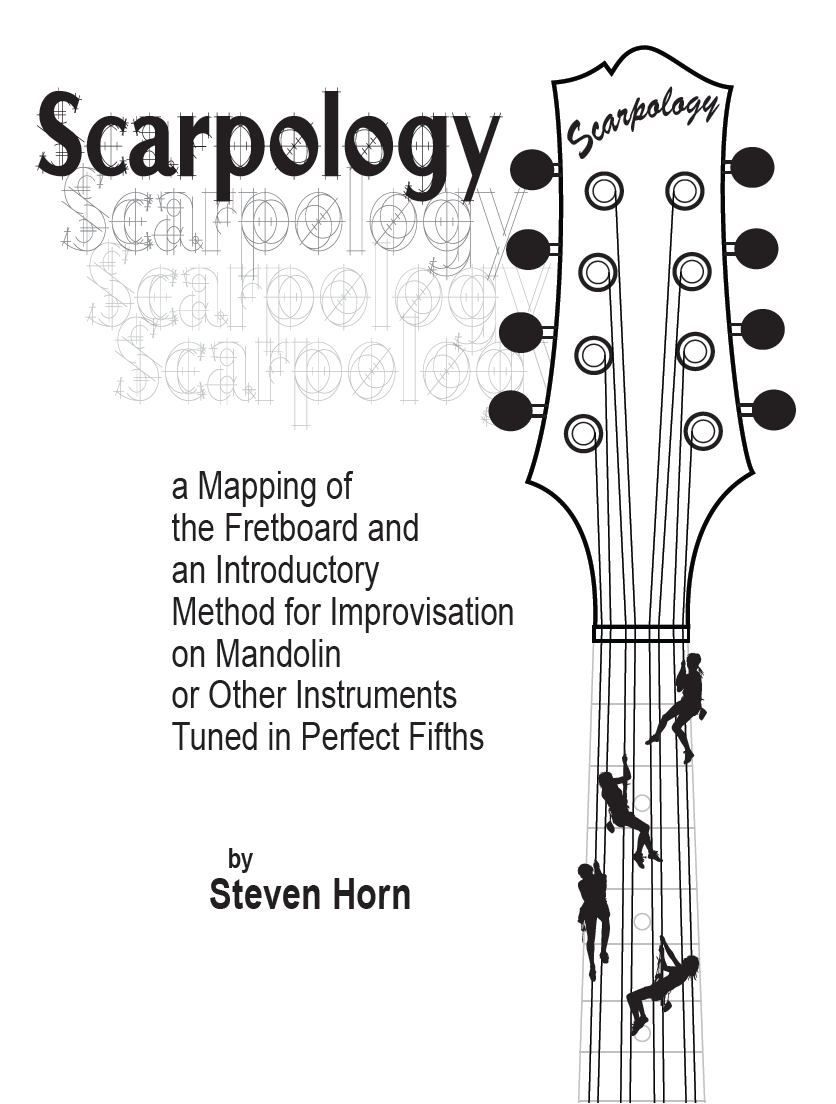
Here are some pieces extracted from the preface of Scarpology: A Mapping of the Fretboard and an Introductory Method for Improvisation on Mandolin and Other Instruments Tuned in Perfect Fifths
Scarpology as a book and comes in both digital and print format. The print version is highly recommended! But there also is a digital version at a greatly reduced price.
Who is this book for?
This book is written to be read by novices or by well-versed musicians who want to increase their playable range to include the entire neck of their instrument* and to be able to play and improvise in any key. This book also is for music instructors who are interested in this method as a teaching tool for their students.
*The target instrument is mandolin, but the information in this book can apply to any instrument tuned in perfect fifths (mandola, octave mandolin, violin, viola, cello, tenor guitar, tenor banjo, etc.)
What is improvisation?
Simply put, improvisation is making it up as you go. The term has similar application in many circles: in music, in theater, in debate, and in daily living. We develop ideas and concepts, build upon them, manipulate them, and embellish them, always taking into consideration the expectations of our audience. In music we can improvise in many styles, and in each style we have room for our individual identity to shine. In this book we will focus on the harmonic aspects of tonal music, learning a framework to support our own creativity and using tools that open up possibilities for exploration.
What is Scarpology?
Scarpology is the study of scarps. A “scarp” is a cross between a scale and an arpeggio. A scarp is like a diatonic scale built on the interval of a third rather than the stepwise interval of a second. The musical term “scarp” mimics the geological term, a shortened use of the word “escarpment” which implies tiers of elevation with hollowed out areas in between.
What do I need to know?
You need to listen. That is the first rule of improvisation. Listen when you play and be open to new ideas so your ear will learn the topics we cover in this book. To start, you will need to be able to hear the difference between major and minor. We will be learning about major and minor keys, scales, modes and chords.
What will I learn?
Using scarpology you will learn how to
- play in any key: major, minor, or modal
- transpose or shift to any other key: major, minor or modal
- play, transpose, improvise over the entire range of your instrument
Do I need to know how to read music?
Reading music is not required, but it may be helpful. It would be good to know the basic elements of music notation and we will be using some terms found in music theory. But this does not mean you need to be good at reading music. This book is written for mandolin players or players of any instrument that is tuned in perfect fifths (tenor guitar, tenor banjo, octave mandolin, violin, viola, cello, etc). You will be able to learn to play as far as your ear can carry you. Whether you read music or not, you will be relying mostly on your ear and may find yourself in the middle of a riff, not knowing which notes you are playing or the key you are playing in.
Why the Author Wrote This Book
Author Steven Horn was well versed in a number of traditional styles that used open strings, mimicking fiddle music, and adhering mostly to a handful of keys and related chords. But when a singer needs to move to a more comfortable key or when horns such as trumpet, clarinet, or saxophone were present and wanted a key that fit well with them, Steve was unable to shift to accommodate them. Steve also was interested in learning music with more complex key shifts and harmonies. Steve Horn came up with this method for his own benefit and thought it should be made available for others to use. He discovered a methodology that melded well with the tuning of mandolin and similar instruments; one that actually took advantage of what the mandolin could do; one that was easy to get a foothold onto and that produced results even in the early stages of learning. So he approaches learning with an attitude of encouragement and pragmatism focusing on Progress Rather Than Perfection!!
Get a copy in either digital and print format. The print version is highly recommended! But there also is a digital version at a greatly reduced price.