Chords

  • | | |

    About Chords for the Mandolin

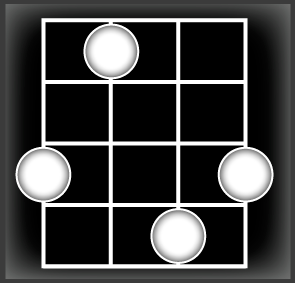
    Mandolin has a pitch range that starts from G below middle C and  spans 3 octaves or more. It’s short string length means a person’s hands can spread over more frets than larger instruments. Moving up the neck, the player will notice a greater ease of reach counteracted by cramped spaces, crowding fingers into miniature shapes to play chords that are easier down low on the neck. This necessitates some change in strategy when playing high up the neck, and generally means that the higher up the neck one chords, the wider the interval spacing becomes. (read more about “Density/Expansivity“.) Although this is true on any stringed instrument, on the mandolin this can be an issue that demands more attention from each individual player depending…
  • |

    Diminished and Half-Diminished Seven Chords

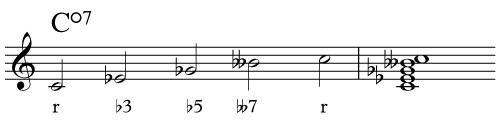
    The diminished seven (1-b3-b5-bb7) and half diminished seven (1-b3-b5-b7) chords are built upon a diminished triad.  Despite this similarity and despite the tendency of some musicians to treat these chords the same, the two can function very differently.  Each can serve in a dominant function and resolve to a major or minor triad whose root is a half-step higher. However, the half diminished seven also functions as a subdominant chord in minor keys (iiø7 – V7 – i7). The ii-V relationship is one of the most common harmonic idioms in jazz and popular music. The fully diminished seven chord almost always functions in a dominant capacity.  It is one of the most easily transposable chords in music and serves as a handy device for transposing…

  • |

    Tetrads – the 6 and 7 chords

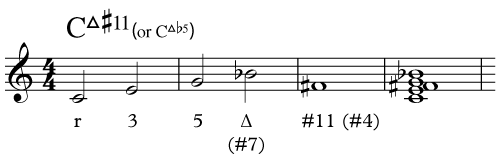
    While conventional harmony is based on the triad, the basic building block in jazz is the four note chord or tetrad, a basic triad with a 6th or 7th scale degree added.  There are 6 basic tetrads that serve as these fundamental building blocks:  three major six chords seventh chords  (aka: dominant seventh or major-minor seventh) major seventh chords (aka: major seventh or major-major seventh) three minor minor six chords minor sevenths (minor-minor sevenths) minor-major sevenths Six Chords The major six chord uses the exact same notes as the (relative) minor seventh chord. That is to say a C6 (C-E-G-A) uses the very same notes as an Am7 (A-C-E-G). The difference between these two names for the same chord depends on how they are used…