|

Tetrads – the 6 and 7 chords

While conventional harmony is based on the triad, the basic building block in jazz is the four note chord or tetrad, a basic triad with a 6th or 7th scale degree added.  There are 6 basic tetrads that serve as these fundamental building blocks:

  •  three major
    • six chords
    • seventh chords  (aka: dominant seventh or major-minor seventh)
    • major seventh chords (aka: major seventh or major-major seventh)
  • three minor
    • minor six chords
    • minor sevenths (minor-minor sevenths)
    • minor-major sevenths

Six Chords

The major six chord uses the exact same notes as the (relative) minor seventh chord. That is to say a C6 (C-E-G-A) uses the very same notes as an Am7 (A-C-E-G). The difference between these two names for the same chord depends on how they are used or how they are voiced.  Many arrangers and players use these interchangeably and there are some instances where it is difficult to say which is really the better term.

C6 chord
C6 – (C – E – G – A)

C6

_____________________________________________________________

Dominant 7 Chords

The dominant 7 chord is found more frequently than any other chord in jazz.  It is also the basis for a slew of more complex chords, using both natural and altered upper tensions. The dominant seven, often referred to simply as a “seven” chord is used to drive a harmonic progression back to its home key. It is also used in jazz and blues, interchangeably with the tonic chord of the home key. With a very strong and popular sound, this chord has frequent and very flexible application.
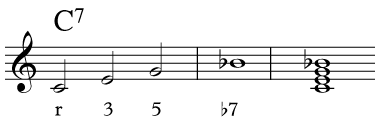
C dominant 7 Chord
C7 (C – E – G – Bb)

C7

_____________________________________________________________

Major Seven

The Major Seven (or major-major seven) chord is used often to add color to a chord where a simple triad would be used. It is sometimes interchanged with the 6 chord. It is known for it’s soft, lush sound, not as driving as the dominant 7 but better suited for delicate applications.
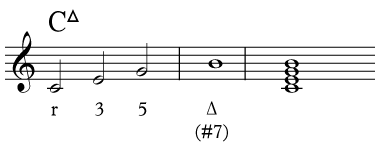
C major seventh chord
C∆7 (C – E – G – B)

C major 7

_____________________________________________________________

Minor Six Chords

The minor six chord is has a slightly esoteric sound and is frequently heard in jazz, particularly in gypsy jazz, a movement spearheaded by guitarist Django Rheinhardt and violinist Stefan Grapelli.
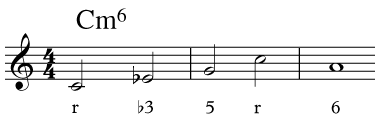
C minor 6 chord
Cm6 (C – Eb – G – A)

Cm6

_____________________________________________________________

Minor Seven Chord

Of the minor tetrads, the minor seven could be considered the most stable.  Rhythm players rely on this chord to play it safe and stay more out of the way of soloists who may veer from the charted path.  A pretty sound on its own, this chord is a frequent choice in jazz circles.
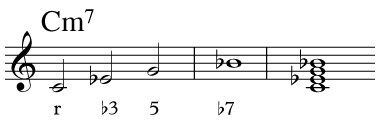
Cm7 (C – Eb – G – Bb)

Cm7

_____________________________________________________________

Minor Major Seven

This is one of the more colorful of the basic tetrads used in jazz. Cool and exotic, choosing this chord is just on the cusp breaking into the wide world of upper tension chords in jazz, a wonderful, exciting sound.
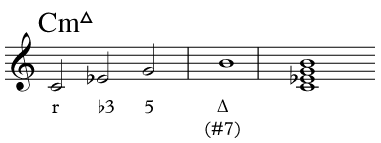
C minor major seventh chord
Cm∆ (C – Eb – G – B)

C minor major 7

_____________________________________________________________


Similar Posts

  • |

    Density/Expansivity in Music

    Sound can be dense or expansive, relatively speaking. In fact, any element of sound or of music can have its own density/expansivity attributes that contribute to the overall density/expansivity of a sound, of a piece or music, of an ensemble, or any element of music or sound. This will be referred to as the Density/Expansivity Factor or D-E Factor. Every musical instrument has it’s own D-E make-up.  Mandolin is relatively expansive for a variety of reasons. But before we go into these characteristics particular to the mandolin, lets talk about the D-E Factor or D-E in general terms. Density could be summed up as “stuff drawn together into close proximity”. A collection of “stuff” could be strewn across it’s measuring scale and therefore expanded, or…

  • |

    Scarpology Testimonials from Seasoned Pros

    Originally written Sept 1, 2013 after the publication of Scarpology. Two Yaaaays and One Maaaay-be In case you haven’t already heard, I wrote a book entitled Scarpology: a Mapping of the Fretboard and an Introductory Method for Improvisation on Mandolin or Other Instruments Tuned in Perfect Fifths. This is what has taken most of my writing time for the past year or longer. It was a huge amount of work and before I went public with it, I wanted to get some feedback from trusted sources and I am happy to report on some very helpful feedback. Of the four professionals I sent copies to, three reported back, one did not. Of the three that reported back, two were highly complimentary and one had some…

  • |

    Major and Minor Tonalities

    Bonaparte Crossing the Rhine in Major Key followed by the same in a minor key. (Bonaparte Crossing the Rhine in Major Key followed by the same in a minor key.) We hear nearly all tonal music (particularly Western tonal music) in either a major or minor key. The home base of any key is the tonic triad made up of scale degrees 1, 3, and 5. What makes the key sound major or minor is whether the third scale degree is a major or minor third in relation to the tonic or home pitch or scale degree 1 (also, assuming the 5th is a perfect 5th as it usually is). All other scale degrees (2, 4, 6, 7) can have various characteristics, either adhering to…

  • |

    Jazz Chord Theory

    With a focus on the tetrad as a basic building block for jazz and popular music today, we hope to offer some basic information on chord theory that will enhance and work in conjunction with the rest of this website. An understanding of theory serves to explain in words what we do in music. This gives us a medium on which to communicate the language of music with our language of the spoken word.

  • |

    Diminished and Half-Diminished Seven Chords

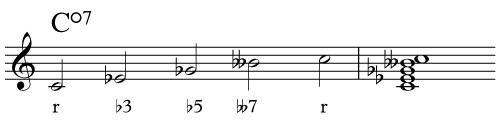
    The diminished seven (1-b3-b5-bb7) and half diminished seven (1-b3-b5-b7) chords are built upon a diminished triad.  Despite this similarity and despite the tendency of some musicians to treat these chords the same, the two can function very differently.  Each can serve in a dominant function and resolve to a major or minor triad whose root is a half-step higher. However, the half diminished seven also functions as a subdominant chord in minor keys (iiø7 – V7 – i7). The ii-V relationship is one of the most common harmonic idioms in jazz and popular music. The fully diminished seven chord almost always functions in a dominant capacity.  It is one of the most easily transposable chords in music and serves as a handy device for transposing…

  • |

    Scarpology Book on Improvisation: a look into the book

    Here are some pieces extracted from the preface of Scarpology: A Mapping of the Fretboard and an Introductory Method for Improvisation on Mandolin and Other Instruments Tuned in Perfect Fifths Scarpology as a book and comes in both digital and print format. The print version is highly recommended! But there also is a digital version at a greatly reduced price. Who is this book for? This book is written to be read by novices or by well-versed musicians who want to increase their playable range to include the entire neck of their instrument* and to be able to play and improvise in any key. This book also is for music instructors who are interested in this method as a teaching tool for their students.*The target…