Similar Posts
Gravity and Levity in Music
The purpose of this article is to offer food for thought more than to define an element or draw a conclusion and your comments are welcome. This is a discourse in music theory although scientifically very soft. The point is simply to better understand the complex nature of what we hear in music. What is Gravity and Levity in music? Gravity/Levity, or the Gravity/Levity factor (G-L factor), is similar in concept to weight. This article will deal with the concept of Gravity/Levity in terms of harmonic content but other aspects of music can have significant bearing on the G-L factor: timbre, tessiatura, a variety of techniques of orchestration, to name a few. Harmonically speaking, the more gravity a musical element has, the more of a…
Jazz Chord Theory
With a focus on the tetrad as a basic building block for jazz and popular music today, we hope to offer some basic information on chord theory that will enhance and work in conjunction with the rest of this website. An understanding of theory serves to explain in words what we do in music. This gives us a medium on which to communicate the language of music with our language of the spoken word.
Scales, Modes & Tonality
Modes have been around even longer than the mandolin. They have survived for centuries in folk music and have emerged to the mainstream of popular and jazz music. While they may sometimes sound exotic, they are actually familiar to us in modern-day music, in standards we all know. This is a break down of the seven diatonic modes as used today.
Diminished and Half-Diminished Seven Chords
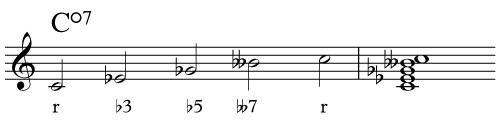
The diminished seven (1-b3-b5-bb7) and half diminished seven (1-b3-b5-b7) chords are built upon a diminished triad. Despite this similarity and despite the tendency of some musicians to treat these chords the same, the two can function very differently. Each can serve in a dominant function and resolve to a major or minor triad whose root is a half-step higher. However, the half diminished seven also functions as a subdominant chord in minor keys (iiø7 – V7 – i7). The ii-V relationship is one of the most common harmonic idioms in jazz and popular music. The fully diminished seven chord almost always functions in a dominant capacity. It is one of the most easily transposable chords in music and serves as a handy device for transposing…