Articles

  • |

    Where This May Lead

    The internet offers us such a wonderful tool for communications, offering many media sources to experience and to learn from. We are lucky today to have such convenient access to so much information available at our wish and not the wish of someone else. Our wish is to share with you and hope you will share back. We hope you enjoy reading and enjoy learning from the content you find on this website. We also hope you will register and offer your comments. Together we make up a community that is already well established on the web. This site is one facet of that community. What we’re doing here is highly promotional. We want to promote music, jazz and particularly the mandolin and its family…
  • |

    Major and Minor Tonalities

    Bonaparte Crossing the Rhine in Major Key followed by the same in a minor key. (Bonaparte Crossing the Rhine in Major Key followed by the same in a minor key.) We hear nearly all tonal music (particularly Western tonal music) in either a major or minor key. The home base of any key is the tonic triad made up of scale degrees 1, 3, and 5. What makes the key sound major or minor is whether the third scale degree is a major or minor third in relation to the tonic or home pitch or scale degree 1 (also, assuming the 5th is a perfect 5th as it usually is). All other scale degrees (2, 4, 6, 7) can have various characteristics, either adhering to…

  • |

    Density/Expansivity in Music

    Sound can be dense or expansive, relatively speaking. In fact, any element of sound or of music can have its own density/expansivity attributes that contribute to the overall density/expansivity of a sound, of a piece or music, of an ensemble, or any element of music or sound. This will be referred to as the Density/Expansivity Factor or D-E Factor. Every musical instrument has it’s own D-E make-up.  Mandolin is relatively expansive for a variety of reasons. But before we go into these characteristics particular to the mandolin, lets talk about the D-E Factor or D-E in general terms. Density could be summed up as “stuff drawn together into close proximity”. A collection of “stuff” could be strewn across it’s measuring scale and therefore expanded, or…

  • |

    Diminished and Half-Diminished Seven Chords

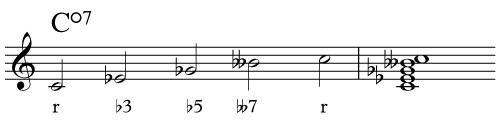
    The diminished seven (1-b3-b5-bb7) and half diminished seven (1-b3-b5-b7) chords are built upon a diminished triad.  Despite this similarity and despite the tendency of some musicians to treat these chords the same, the two can function very differently.  Each can serve in a dominant function and resolve to a major or minor triad whose root is a half-step higher. However, the half diminished seven also functions as a subdominant chord in minor keys (iiø7 – V7 – i7). The ii-V relationship is one of the most common harmonic idioms in jazz and popular music. The fully diminished seven chord almost always functions in a dominant capacity.  It is one of the most easily transposable chords in music and serves as a handy device for transposing…

  • |

    Tetrads – the 6 and 7 chords

    While conventional harmony is based on the triad, the basic building block in jazz is the four note chord or tetrad, a basic triad with a 6th or 7th scale degree added.  There are 6 basic tetrads that serve as these fundamental building blocks:  three major six chords seventh chords  (aka: dominant seventh or major-minor seventh) major seventh chords (aka: major seventh or major-major seventh) three minor minor six chords minor sevenths (minor-minor sevenths) minor-major sevenths Six Chords The major six chord uses the exact same notes as the (relative) minor seventh chord. That is to say a C6 (C-E-G-A) uses the very same notes as an Am7 (A-C-E-G). The difference between these two names for the same chord depends on how they are used…

  • | | |

    The G-L Factor Found in the Diatonic Modes

    The Seven Diatonic Modes: an established system for comparison The seven diatonic modes are have their roots in early music of the Medieval and Renaissance eras. These modes survived and thrived through the centuries in folk music and can be found today in popular music, rock, country, blue grass and jazz. Although the original modes of early times have been expanded upon (even Ionian and Locrian modes are later additions), we can use the 7 diatonic modes as basis for “weighing in” regarding the G-L Factor of other scales and elements of music. Ionian mode – identical to the major scale “c” to “c” using white notes on the piano Dorian mode – a minor scale with a raised 6th scale degree “d” to “d”…