| | |

The G-L Factor Found in the Diatonic Modes

The Seven Diatonic Modes: an established system for comparison

The seven diatonic modes are have their roots in early music of the Medieval and Renaissance eras. These modes survived and thrived through the centuries in folk music and can be found today in popular music, rock, country, blue grass and jazz. Although the original modes of early times have been expanded upon (even Ionian and Locrian modes are later additions), we can use the 7 diatonic modes as basis for “weighing in” regarding the G-L Factor of other scales and elements of music.

  • Ionian mode –
    • identical to the major scale
    • “c” to “c” using white notes on the piano
  • Dorian mode –
    • a minor scale with a raised 6th scale degree
    • “d” to “d” using white notes on the piano
  • Phrygian mode –
    • a minor scale with a lowered 2nd scale degree
    • “e” to “e” using white notes on the piano
  • Lydian mode –
    • a major scale with a raised 4th scale degree
    • “f to “f” using white notes on the piano
  • Mixolydian mode –
    • a major scale with a lowered 7th scale degree
    • “g” to “g” using white notes on the piano
  • Aeolian mode –
    • identical to the “natural” minor scale
    • “a” to “a” using white notes on the piano
  • Locrian mode –
    •  a minor scale (or better termed “diminished scale”) with a lowered 2nd and a lowered 5th scale degree
    • “b” to “b” using white notes on the piano

How would these modes relate to each other in terms of the G-L factor?  Let us compare these to each other, built upon the same tonic pitch level. If an example has more raised scale degrees, it would have more levity. Likewise, more lowered scale degrees indicates more gravity.  Here are the modes listed in order with the most levity at the top, the most gravity at the bottom:

—-Levity—————————–

      • Major Modes (3rd degree raised)
        • Lydian (raised 4th)
        • Ionian
        • Mixolydian (lowered 7th)
      • Minor Modes (3rd degree lowered)
        • Dorian  (raised 6th)
        • Aeolian
        • Phrygian (lowered  2nd)
      • Diminished Mode
        • Locrian (lowered 2nd & 5th)

—-Gravity—————————–

Using this arrangement of the diatonic modes as a scale, we can apply the GL factor to musical elements in a way similar to the methods of measuring temperature.  Fahrenheit and Centigrade each establish their own “zero” point. We could do much the same by selecting a point on this modal G-L spectrum and move up or down the spectrum from that point using positive or negative numbers.

Lets select “dorian” as a zero point and call our G-L factor, G-L-Dorian. What G-L value would this give to the other modes? Mixolydian would have a value of 1 G-L-Dorian while Aeolian would equal -1 G-L-Dorian and other modes would compare respectively.

If we used “locrian” as the base, we would have only positive integers to measure these modes but it may be valuable to investigate the possibility of a mode or some other element of music, an interval, tone-cluster, chord, scale….. that could serve as “absolute zero” for the purpose of comparing all elements of music… a valuable consideration for another time.

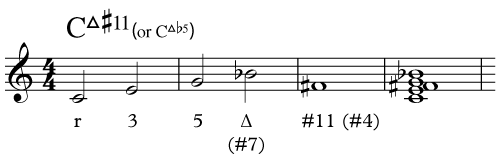
One interesting thing to point out with this modal spectrum is that altered pitches at the extreme ends, the very elements that render the most gravity or the most levity, are one in the same. The sharp 4 of the Lydian mode is the same pitch as the flat 5 of the Locrian mode. When presented in context of these modes or scales, it is clear and easy to see the difference between the sharp 4 and flat 5. However, in jazz or other styles of music that are more complex or free in nature, it may not be as easy to discern. Flat 5 chords might function more as sharp 11 (sharp 4) chords. Usually, the ear picks up on this so all rules and ideas put aside, the ear is the ultimate judge of how music sounds.
Similar Posts

  • |

    Scarpology Book on Improvisation: a look into the book

    Here are some pieces extracted from the preface of Scarpology: A Mapping of the Fretboard and an Introductory Method for Improvisation on Mandolin and Other Instruments Tuned in Perfect Fifths Scarpology as a book and comes in both digital and print format. The print version is highly recommended! But there also is a digital version at a greatly reduced price. Who is this book for? This book is written to be read by novices or by well-versed musicians who want to increase their playable range to include the entire neck of their instrument* and to be able to play and improvise in any key. This book also is for music instructors who are interested in this method as a teaching tool for their students.*The target…

  • | | |

    About Chords for the Mandolin

    Mandolin has a pitch range that starts from G below middle C and  spans 3 octaves or more. It’s short string length means a person’s hands can spread over more frets than larger instruments. Moving up the neck, the player will notice a greater ease of reach counteracted by cramped spaces, crowding fingers into miniature shapes to play chords that are easier down low on the neck. This necessitates some change in strategy when playing high up the neck, and generally means that the higher up the neck one chords, the wider the interval spacing becomes. (read more about “Density/Expansivity“.) Although this is true on any stringed instrument, on the mandolin this can be an issue that demands more attention from each individual player depending…

  • | |

    Gravity and Levity in Music

    The purpose of this article is to offer food for thought more than to define an element or draw a conclusion and your comments are welcome. This is a discourse in music theory although scientifically very soft. The point is simply to better understand the complex nature of what we hear in music. What is Gravity and Levity in music? Gravity/Levity, or the Gravity/Levity factor (G-L factor), is similar in concept to weight. This article will deal with the concept of Gravity/Levity in terms of harmonic content but other aspects of music can have significant bearing on the G-L factor: timbre, tessiatura, a variety of techniques of orchestration, to name a few. Harmonically speaking, the more gravity a musical element has, the more of a…

  • |

    Density/Expansivity in Music

    Sound can be dense or expansive, relatively speaking. In fact, any element of sound or of music can have its own density/expansivity attributes that contribute to the overall density/expansivity of a sound, of a piece or music, of an ensemble, or any element of music or sound. This will be referred to as the Density/Expansivity Factor or D-E Factor. Every musical instrument has it’s own D-E make-up.  Mandolin is relatively expansive for a variety of reasons. But before we go into these characteristics particular to the mandolin, lets talk about the D-E Factor or D-E in general terms. Density could be summed up as “stuff drawn together into close proximity”. A collection of “stuff” could be strewn across it’s measuring scale and therefore expanded, or…

  • |

    Jazz Chord Theory

    With a focus on the tetrad as a basic building block for jazz and popular music today, we hope to offer some basic information on chord theory that will enhance and work in conjunction with the rest of this website. An understanding of theory serves to explain in words what we do in music. This gives us a medium on which to communicate the language of music with our language of the spoken word.