|

Jazz Chord Theory

This area of this fledgling website is, itself, a work in progress at this time. There is a lot of information online about jazz chords and music theory. What is planned for this site is to offer a beginning reference to accompany other articles on the site to help with a better understanding of that content. This will never be an authoritative source on the subject of music theory or jazz but will hopefully serve to encourage the pursuit of jazz particularly for mandolinists and other instrumentalists who play similar instruments.

What we currently have as a basic start is:

Our conceptual outline is to focus on the tetrad as the basic building block and move to 9ths, 11ths, 13ths and altered versions of all these.

Thank you for your patience. Please check back later.
Similar Posts

  • |

    Density/Expansivity in Music

    Sound can be dense or expansive, relatively speaking. In fact, any element of sound or of music can have its own density/expansivity attributes that contribute to the overall density/expansivity of a sound, of a piece or music, of an ensemble, or any element of music or sound. This will be referred to as the Density/Expansivity Factor or D-E Factor. Every musical instrument has it’s own D-E make-up.  Mandolin is relatively expansive for a variety of reasons. But before we go into these characteristics particular to the mandolin, lets talk about the D-E Factor or D-E in general terms. Density could be summed up as “stuff drawn together into close proximity”. A collection of “stuff” could be strewn across it’s measuring scale and therefore expanded, or…

  • | | |

    The G-L Factor Found in the Diatonic Modes

    The Seven Diatonic Modes: an established system for comparison The seven diatonic modes are have their roots in early music of the Medieval and Renaissance eras. These modes survived and thrived through the centuries in folk music and can be found today in popular music, rock, country, blue grass and jazz. Although the original modes of early times have been expanded upon (even Ionian and Locrian modes are later additions), we can use the 7 diatonic modes as basis for “weighing in” regarding the G-L Factor of other scales and elements of music. Ionian mode – identical to the major scale “c” to “c” using white notes on the piano Dorian mode – a minor scale with a raised 6th scale degree “d” to “d”…

  • |

    Scarpology Book on Improvisation: a look into the book

    Here are some pieces extracted from the preface of Scarpology: A Mapping of the Fretboard and an Introductory Method for Improvisation on Mandolin and Other Instruments Tuned in Perfect Fifths Scarpology as a book and comes in both digital and print format. The print version is highly recommended! But there also is a digital version at a greatly reduced price. Who is this book for? This book is written to be read by novices or by well-versed musicians who want to increase their playable range to include the entire neck of their instrument* and to be able to play and improvise in any key. This book also is for music instructors who are interested in this method as a teaching tool for their students.*The target…

  • |

    Diminished and Half-Diminished Seven Chords

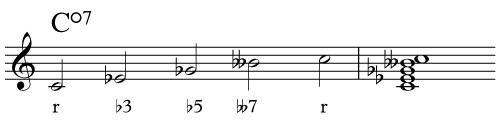
    The diminished seven (1-b3-b5-bb7) and half diminished seven (1-b3-b5-b7) chords are built upon a diminished triad.  Despite this similarity and despite the tendency of some musicians to treat these chords the same, the two can function very differently.  Each can serve in a dominant function and resolve to a major or minor triad whose root is a half-step higher. However, the half diminished seven also functions as a subdominant chord in minor keys (iiø7 – V7 – i7). The ii-V relationship is one of the most common harmonic idioms in jazz and popular music. The fully diminished seven chord almost always functions in a dominant capacity.  It is one of the most easily transposable chords in music and serves as a handy device for transposing…

  • |

    Tetrads – the 6 and 7 chords

    While conventional harmony is based on the triad, the basic building block in jazz is the four note chord or tetrad, a basic triad with a 6th or 7th scale degree added.  There are 6 basic tetrads that serve as these fundamental building blocks:  three major six chords seventh chords  (aka: dominant seventh or major-minor seventh) major seventh chords (aka: major seventh or major-major seventh) three minor minor six chords minor sevenths (minor-minor sevenths) minor-major sevenths Six Chords The major six chord uses the exact same notes as the (relative) minor seventh chord. That is to say a C6 (C-E-G-A) uses the very same notes as an Am7 (A-C-E-G). The difference between these two names for the same chord depends on how they are used…

  • |

    Mandolin: A Prospector’s Dream

    The mandolin can be soft and delicate or robust and driving. It can be sweet or savory. The mandolin offers color, melodic agility, percussive rhythm to any musical setting. It is a traditional part of many musical genres: classical, Neapolitan, jazz, old time, Bluegrass, Country Western and is found in many other genres as well.

    Learning its potential is the purpose of this blog, to share in the community of players and listeners, of composers and arrangers, band leaders and their audiences.