
Mandolin-Family Chord Guide
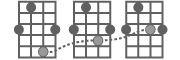
A handy, printable guide to moveable chords for mandolin (or any stringed instrument tuned in fifths) freeing the player from the dependency on open strings and a limited number of keys. This enables easy migration to any key of choice, up or down the neck or across the strings.
While any diagram can be played in the first position on the neck and therefore use open strings, the true value is that the diagram can be used in any position on the neck. These chord diagrams display shapes that are of reasonable reach for any size hand. You can find wider reaches in other chord books and find shapes that make use of open strings with fretted notes that would otherwise be beyond the stretch of most players’ hands. While that is useful especially with some musical styles, this book focuses on shapes that utilize good voicing and demonstrate multiple inversions of a chord that can move to any position and thereby transpose to any key.
This book requires an understanding of harmonic relations in music. This can come from a knowledge of music and music theory OR it can come from practical application, practice, and a good ear. Either way or both ways are good and with patience and persistance, you can develop an expanded sense of musicianship and an enhanced relationship with your instrument.
I would like to acknowledge Thad Bonduris of Bonduris Music in Denton, Texas for help in understanding many musical considerations concerning the use of chords and chord voicing. Thad and his staff teach a variety of styles of music on many instruments. Thad is a huge asset to the community providing entertainment, education and an enthusiasm that spreads to young and old alike.
I would like to acknowledge Dr. Leon Peek who offers his eyes and ears as well as his fortuitous voice to provide insight and feedback, wit and wisdom and always a different way to do whatever a person has in mind.
I would like to acknowledge my wife Jenny and two cats for their patience as what I play isn’t always pretty but at least it isn’t always banjo.
The PDF is set up to print on US Letter Size (8.5×11 inch) paper. If your printer supports two-sided printing or if you take this to a copy center that provides that service, please see that the title page prints on the right side of the spread. This follows the document setup and guarantees that certain pages open across from each other. Page spreads such as for tetrads will then be visible at a glance without turning pages.